People ask us all the time how you build a house in Belize — on an island, on the water, two thousand miles from home. This is the honest version: the people, the process, the boats full of materials, the permits, and the numbers. We’re a married couple, not developers, and we wrote this for anyone dreaming of visiting, building, or investing in Belize, because when we started, this was the article we wished we could have read.
We are the Owners of Black Orchid Oasis, a private beachfront villa on the calm, sargassum-free side of Ambergris Caye in Secret Beach. What follows is everything we learned turning a raw, low-lying lot into a home — and a heartfelt thank-you to the Belizeans and expats who built it with us.
It started with a greeting
We first visited Belize in February 2019. We almost didn’t — it wasn’t the obvious choice. But within a day we understood why people never leave. Walking through Belize City, a stranger passing on foot looked up, smiled, and called out, “Every day is a beautiful day in Belize!” — and clearly meant it. That warmth, repeated everywhere we went, is the thing we remember most clearly from that first trip.
Then there was the water. On the leeward shore of Ambergris Caye the Caribbean is bath-warm and waist-deep for a hundred yards, so clear you can count your toes — averaging about 79°F (26°C) in winter and 84°F (29°C) in summer. Best of all, this side of the island is sargassum-free: the calm, clear, seaweed-free water that travelers dream about and increasingly can’t find elsewhere in the Caribbean. We waded in and, somewhere out there, made up our minds. The warmth of the water sealed it. We flew home, but a part of us stayed.
Why Belize — and not somewhere else
We looked seriously at the alternatives. We weighed Belize against Roatán, Costa Rica, and Mexico, and kept coming back to the same conclusion: for a North American couple, the business and political climate in Belize was simply easier to trust. English is the official language, so contracts, permits, and bank paperwork are all in English. The Belize dollar is pegged 2:1 to the U.S. dollar, so there are no currency surprises. The legal system is English common law, property rights are clear, and — crucially — foreigners can own land outright, with the same fee-simple title protections as citizens.
That combination — a stable democracy, a familiar legal framework, no currency risk, and a genuine welcome for foreign owners — is rarer in the region than you’d think. We wrote a longer, fact-checked comparison if you want the full breakdown: Belize vs. Roatán vs. Costa Rica vs. Mexico. For us, the decision was equal parts spreadsheet and gut. The spreadsheet said Belize made sense. The gut remembered the greeting.
Why the north of the island — and why now
We didn’t just choose Belize; we chose the north end of Ambergris Caye, where Secret Beach sits. The first reason was that sargassum-free water — the calm, clear leeward shore is exactly what tourists want, and it’s the most important amenity we could invest in, because it’s the one you can’t build.
The second reason was the trajectory. In 2024 the Government of Belize, working with the Inter-American Development Bank, published a Strategic Plan for Ambergris Caye Sustainable Development — a Vision 2045 commissioned by a national task force. Its conclusion, in plain terms: the island’s growth is moving north, and it should be guided sustainably. The plan projects the island’s population climbing toward roughly 31,000 by 2045, anchors future growth with high-impact projects like a new airport and cargo port, and stresses sustainability on an island where nearly half the land is protected. For us, that was the investor’s tell: the quietest, clearest-water side of the island is also the side with the most room to grow — thoughtfully.
The land: bought direct, with seller financing
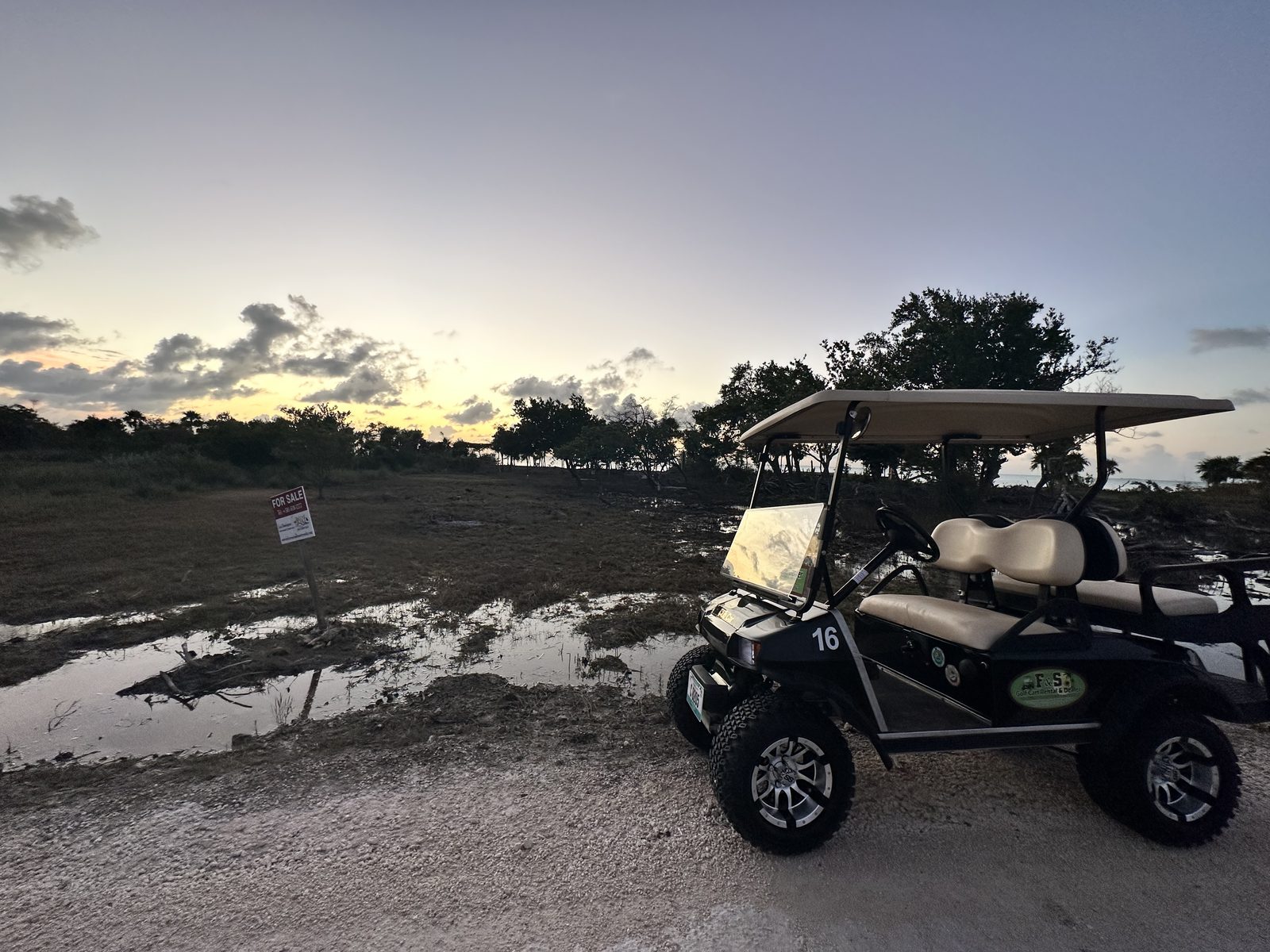
In March 2023 we flew down to walk the land in person. On March 21, 2023 we stood on the lot, met the sellers face to face, and looked out at that impossible, sargassum-free water. Two days later, on March 23, 2023, we signed. The parcel gives us 65 feet of beachfront on the leeward shore, north of San Pedro Town.
Here’s the part that surprises people: we bought directly from the sellers, with no realtor, and they offered seller financing. The purchase price was US$395,000. We put $150,000 down and financed the balance at 8% on a 30-year amortization — with no pre-payment penalty, so we could pay it down as fast as we liked. We did exactly that, paying off the loan in full in January 2024. While the loan was outstanding, title was held in escrow by a Belize title company, transferring to us on payoff.
Doing owner financing in a foreign country felt daunting at first. What made it feel safe was Zaida at Belize Title Services, who built process and confidence into the paperwork early and walked us through every step. We later formed a Belize company, Black Orchid Oasis Ltd., and placed the title in the company’s name — the standard, clean path for foreign owners.
Filling, designing, and permitting
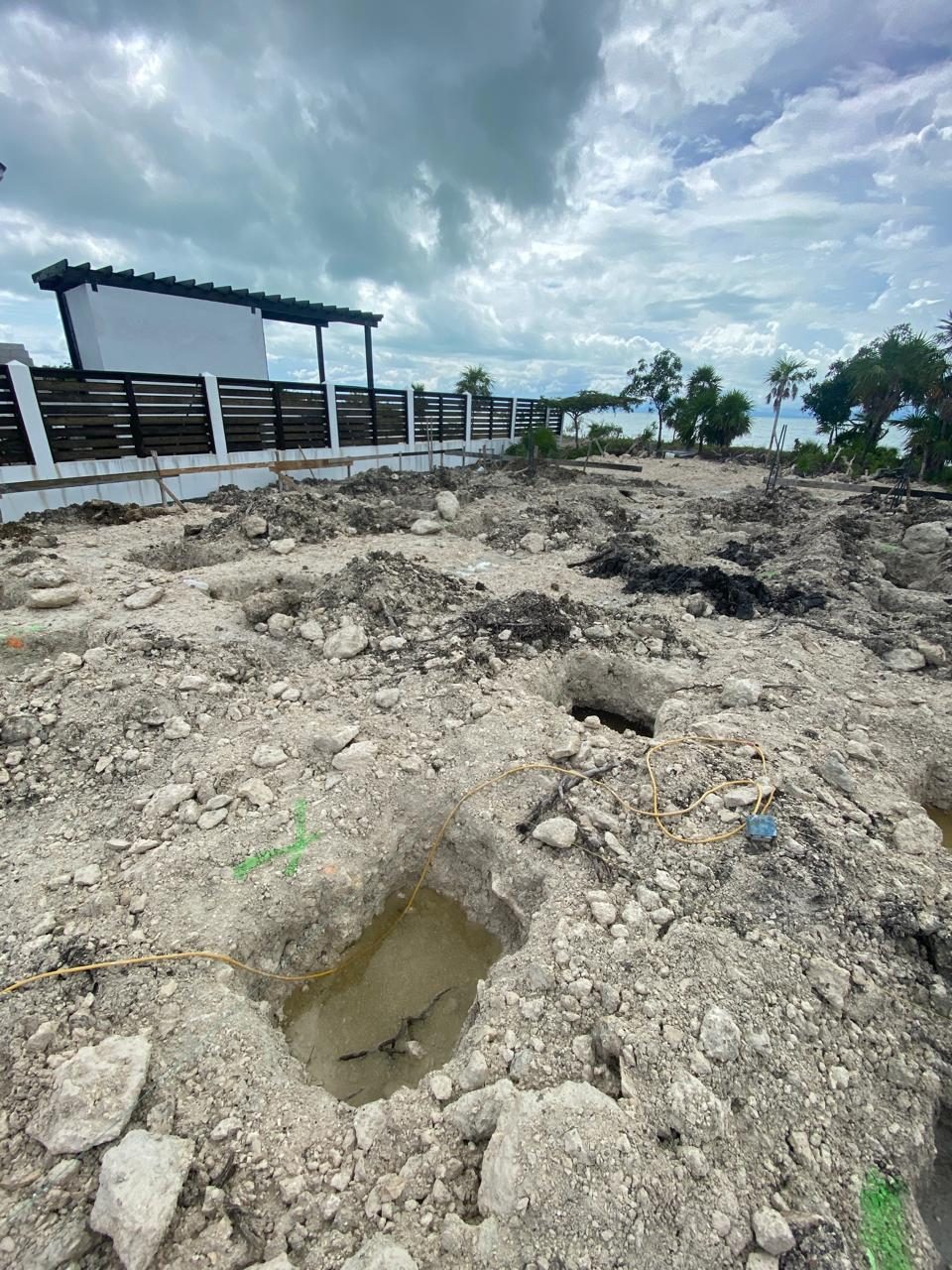
Beachfront land on a caye is low and often needs to be raised before you can build. Our first real work on the property was filling the lot — 56 truckloads of quarried fill hauled up from north of town and spread by bulldozer, for about US$22,400. We worked with Javier Zaldivar of Zaldivar Developments on that filling, on the initial architectural design, and on shepherding the project through permitting.
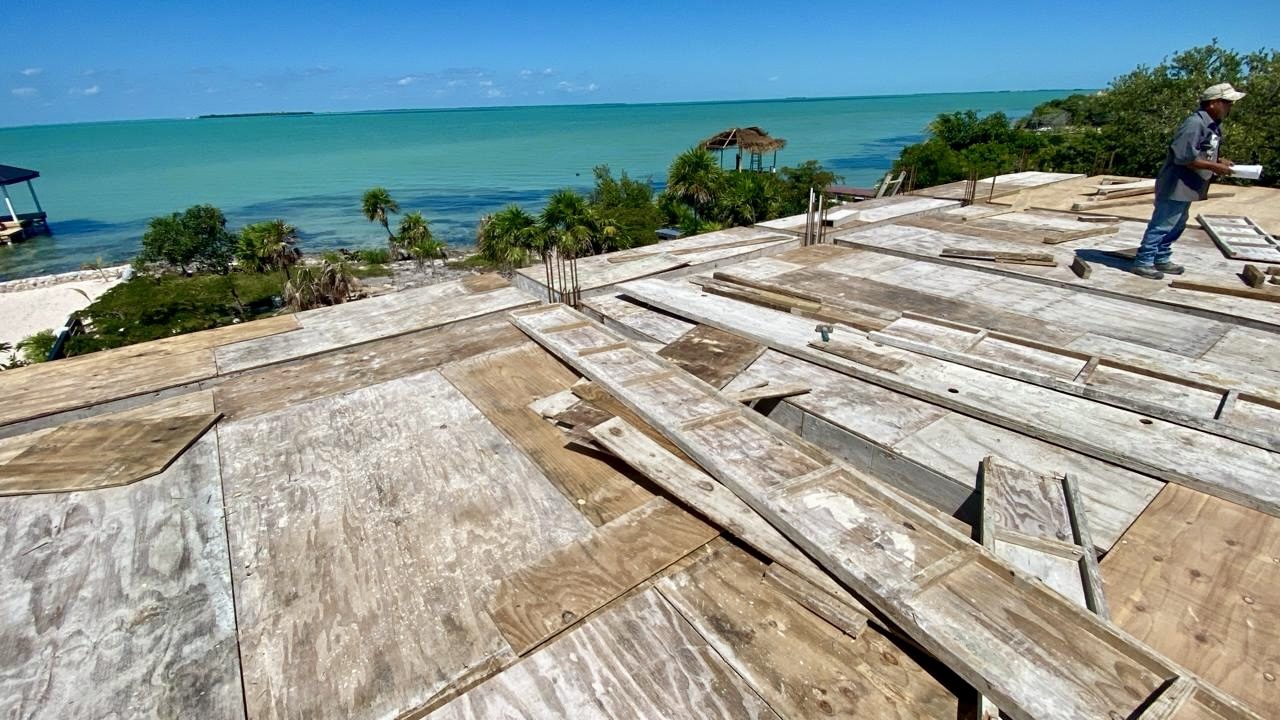
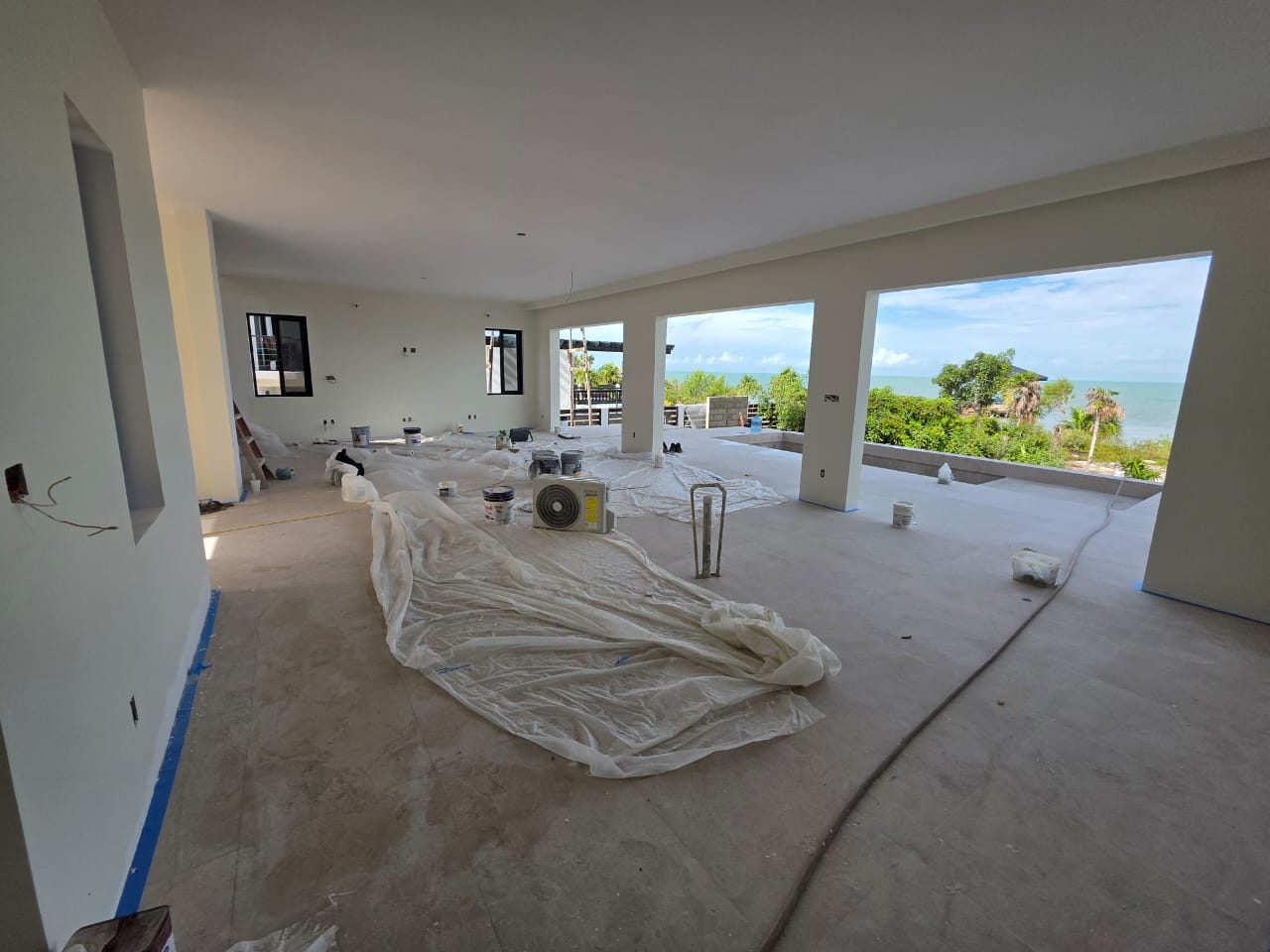
The design that emerged is a two-story, reinforced-concrete villa of about 3,000 square feet, plus a separate 520-square-foot casita — concrete foundation, exterior block walls, and a concrete roof — wrapped in wide covered decks and balconies so nearly every room opens to the sea, with a pool tucked into the deck. Permitting ran through the San Pedro Town Building Unit and Belize’s Central Building Authority, with the structural and electrical engineering signed off by registered local engineers. The formal No Objection and Permit to Commence Building Works were issued in February 2025.
One pleasant surprise: permitting here was faster than back home. What can take many months in Washington State, where we live, took weeks in Belize.
Choosing our builder: Caye Design
As the project moved from paper to poured concrete, we made a decision that shaped everything after it: we brought in Kevin at Caye Design to build it. It came down to timing, project alignment, and communication — Kevin is a fellow North American (Canadian), and working with someone who shared our standards and spoke our shorthand made a two-thousand-mile build feel manageable.
Behind the scenes, Nova at Caye Design — Kevin’s wife — handled all of the accounting, flawlessly and on time, which on a build with hundreds of invoices in two currencies is worth its weight in gold. Kevin and Nova have since opened Da Munch House, a restaurant right at the entrance to Secret Beach — so the people who built our home are now feeding the neighborhood, too.
Building where everything arrives by boat
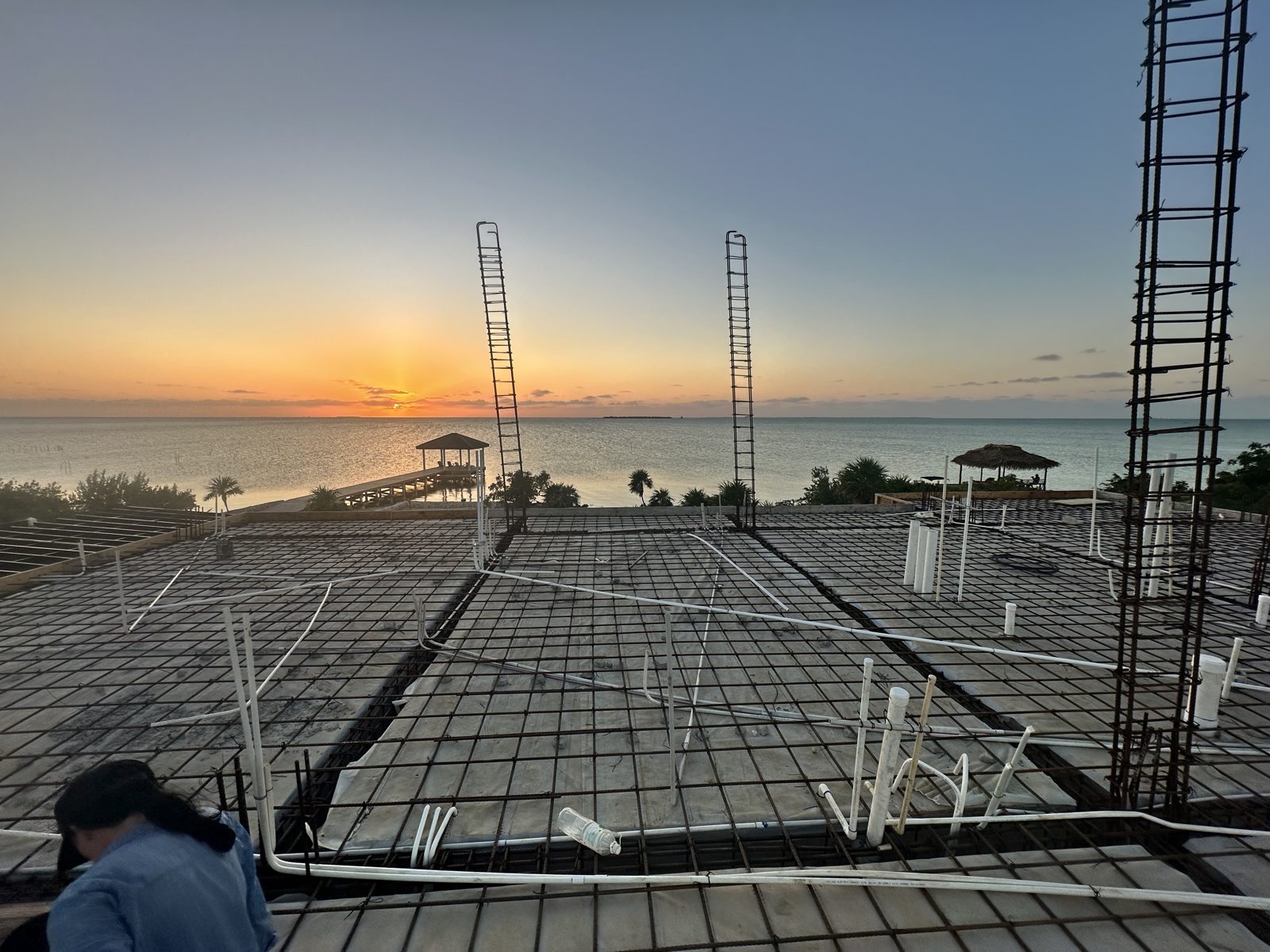
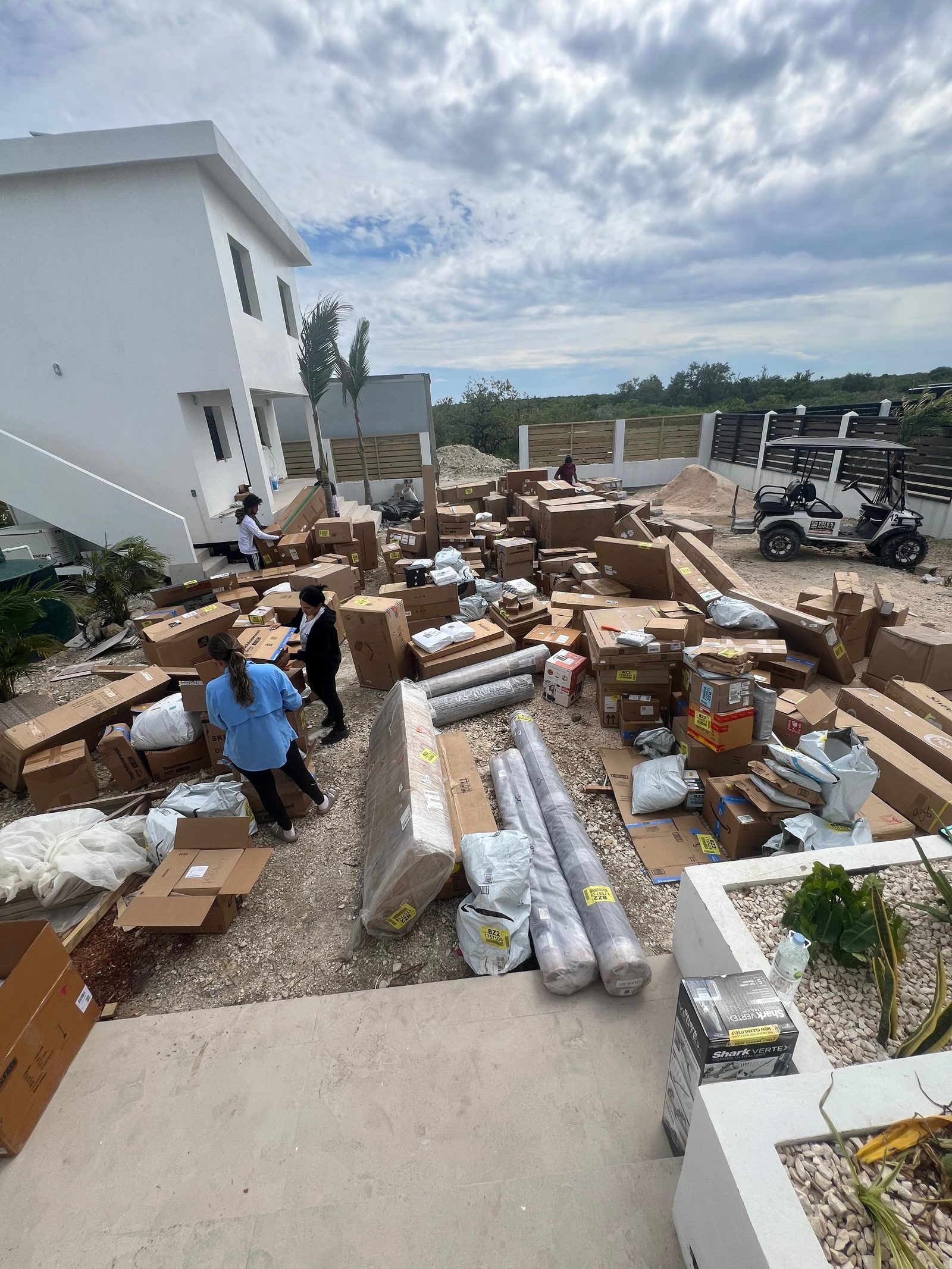
Here is the part mainland builders underestimate. There is no big-box hardware store on the caye, no ready-mix truck idling around the corner. Almost every bag of cement, length of rebar, tile, fixture, and appliance arrives by barge or boat, then moves the last stretch by truck and golf cart. Freight and duty aren’t footnotes here; they’re a real, recurring share of the budget, and they reward anyone who plans ahead and consolidates loads.
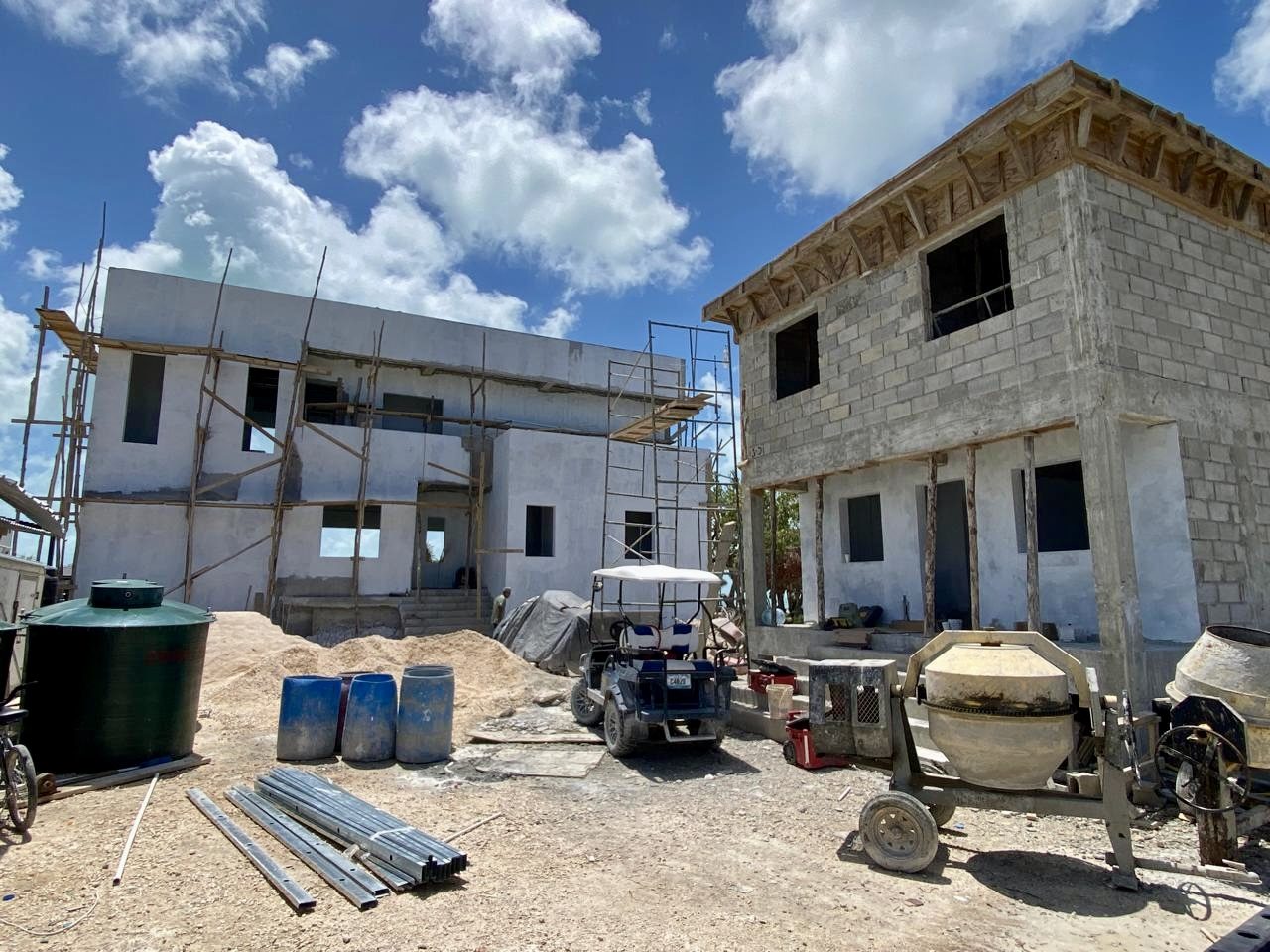
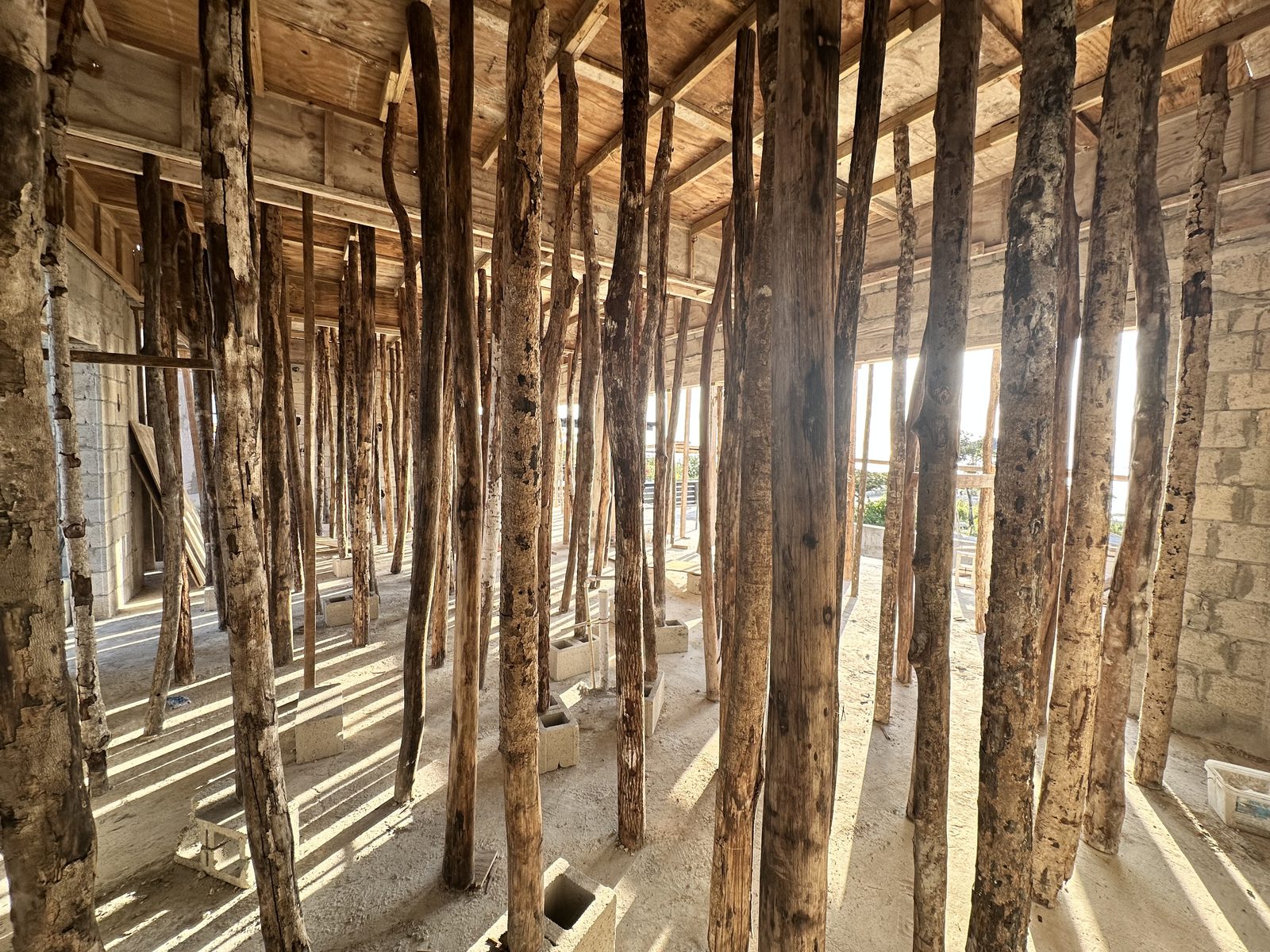
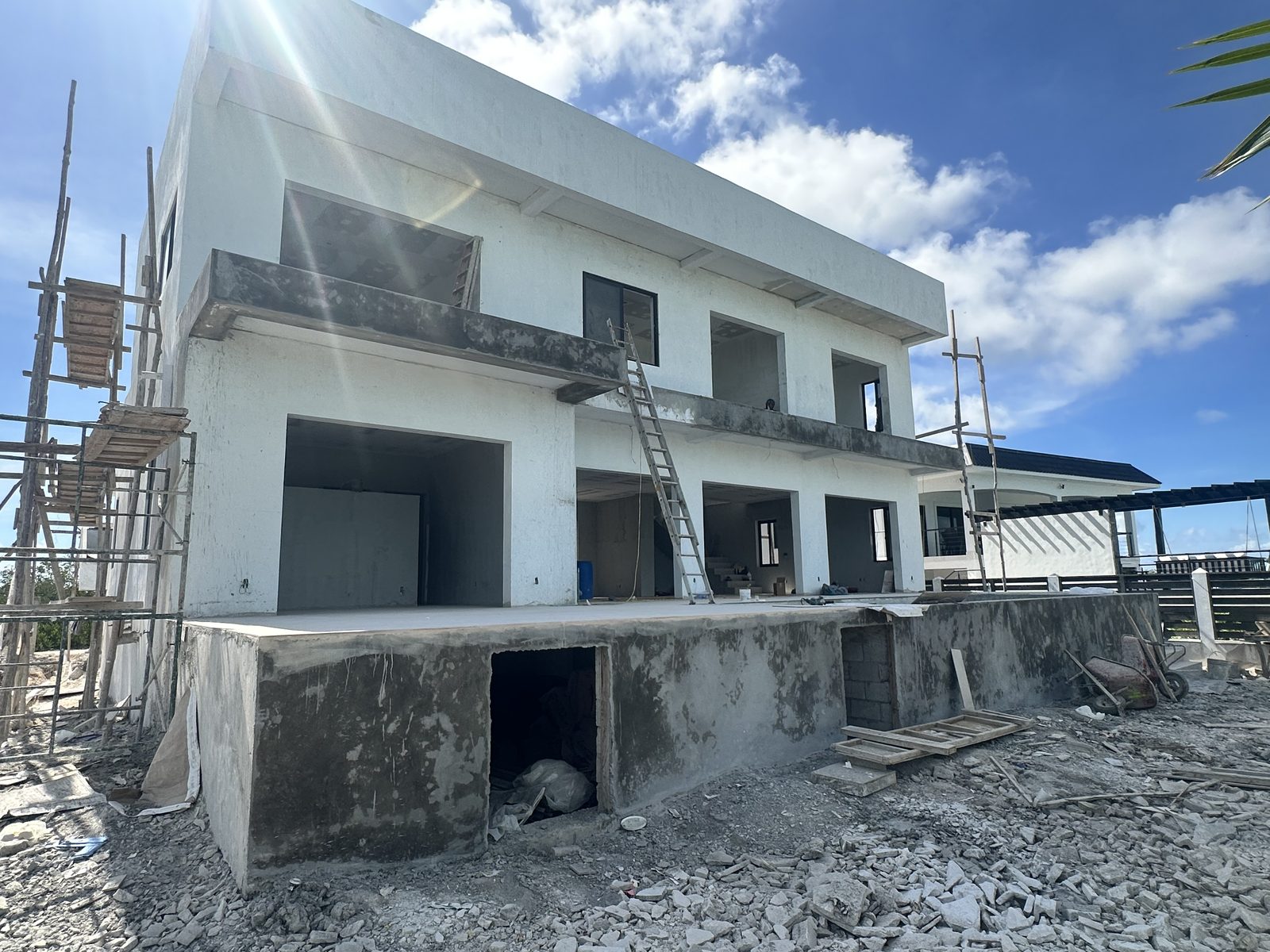
The structure went up the way Belizean homes do: poured-concrete columns and beams, infilled with concrete block, tied together with a great deal of rebar — a house built to stand up to weather. One detail visitors always notice in the progress photos is the scaffolding: not steel frames but hand-cut “bushsticks,” straight poles harvested locally and lashed into place by crews who have done it this way for generations. It looks improvised. It isn’t. It works.
The local hands that built it
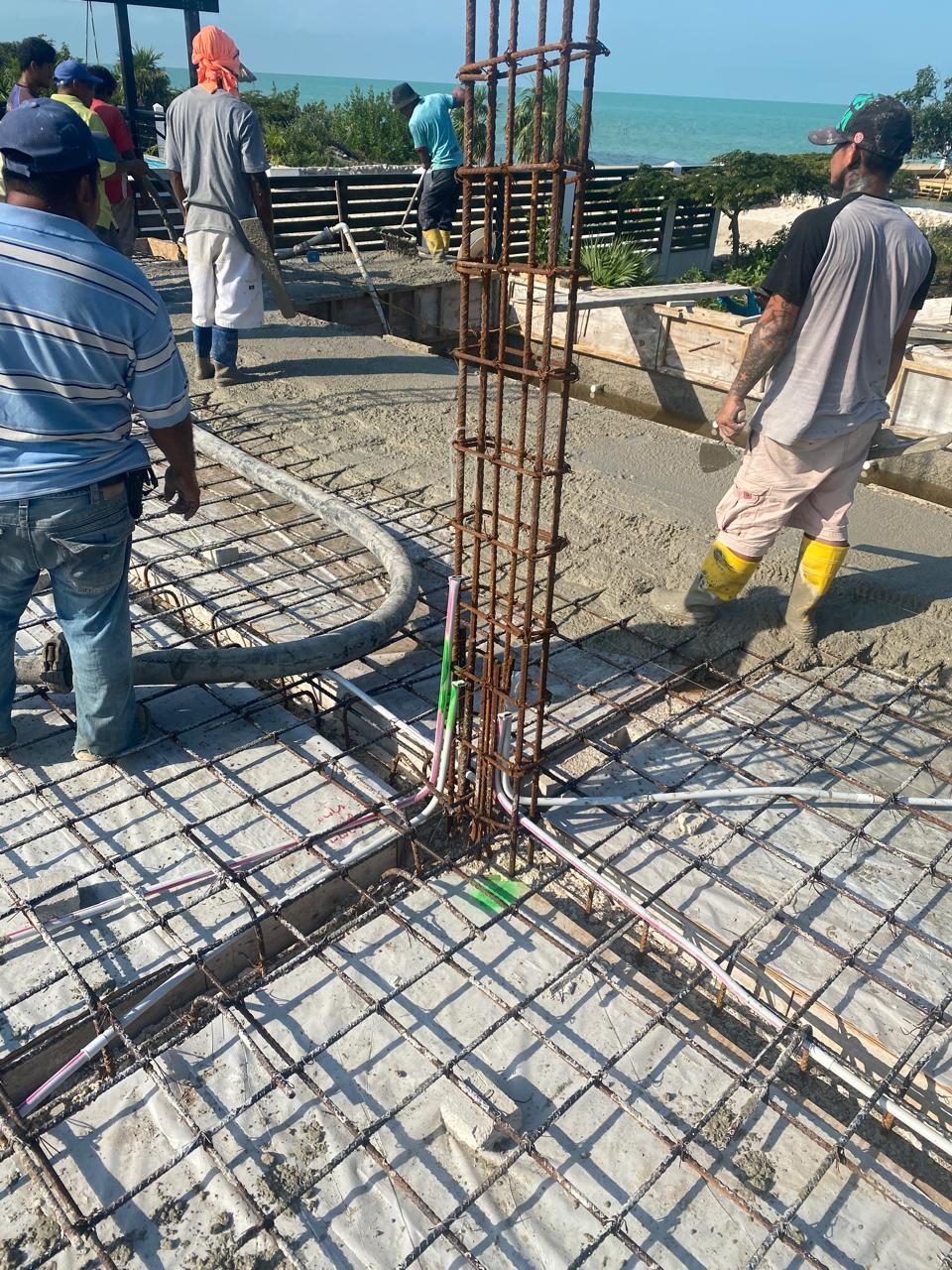
A house is only as good as the people who build it, and ours was built by Belizeans who took real pride in their work. Here is a detail that still humbles us: the concrete was mixed on site and moved by the bucket — every square foot of floor and wall poured by hand — except on the bigger pour days, when timing was important and the pace picked up. Some of those days saw upwards of fifty local Belizeans working at once. Incredible work ethic and passion were, quite literally, poured into this project. The single largest line in the whole budget was their labor, and it was worth every dollar. We came to know the site leads by name — Salvador, Aiden, Santos and the rest of the crew.
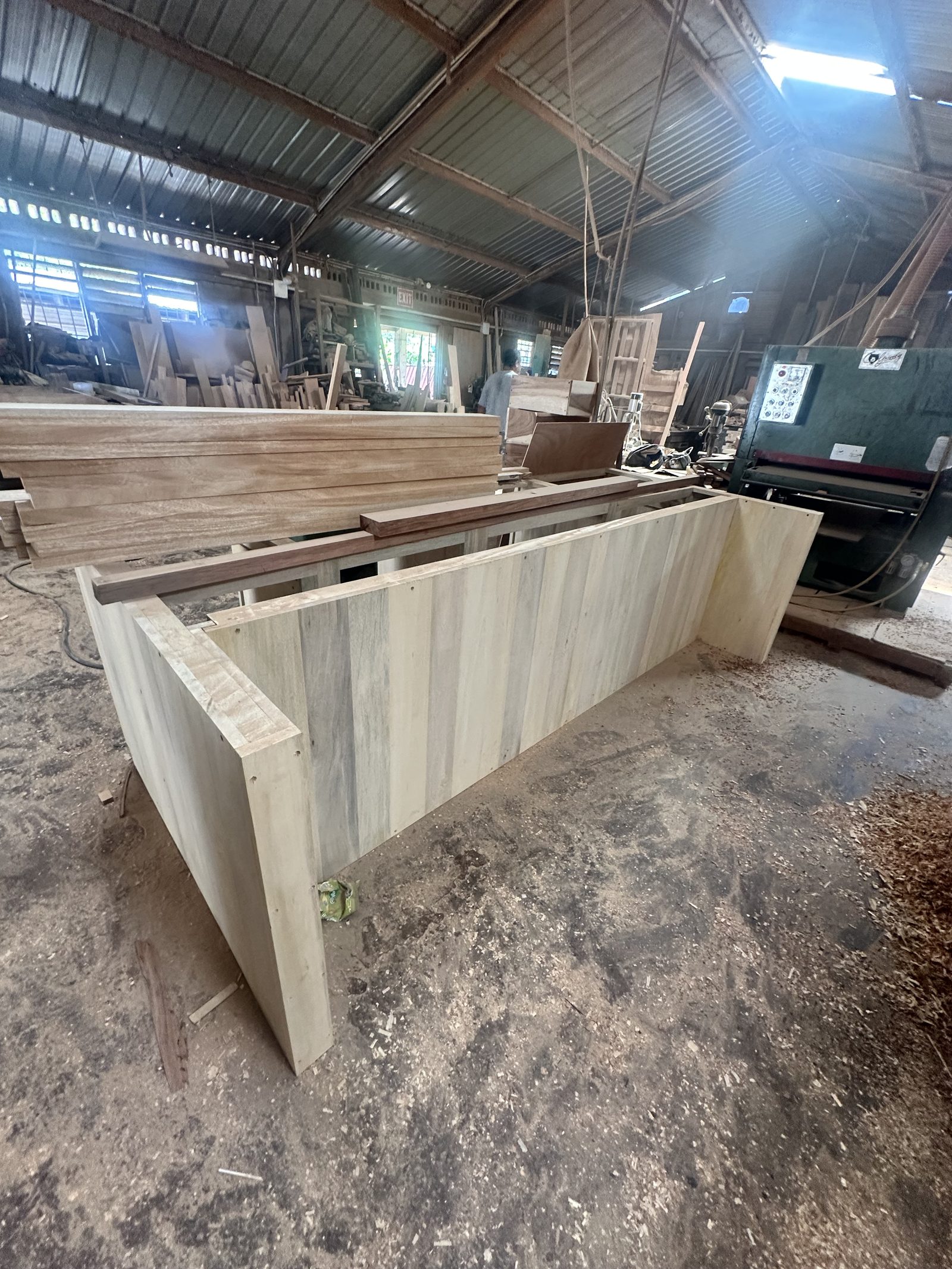
For the millwork we turned to Graniel’s Construction & Cabinet in San Pedro, whose craftsmen built the custom doors, the kitchen and island, the vanities and closets, and a houseful of bespoke furniture — the beds, the long dining table, the floating shelves — to order. What made Graniel’s a joy was Avi, whose extreme attention to detail and put-the-customer-first instinct turned a complicated cabinetry order into one of the most rewarding parts of the project. The exterior doors and windows were sourced from Mexico, shipped in to meet the island’s glass and weather demands.
The list of trades and small island businesses who touched this house is long, and we’re proud of it: the plasterers, tile-setters, painters, electricians, and plumbers; San Pedro Window Treatments for the roller shades and blackout drapes; and Sew What in San Pedro for custom soft furnishings. Every one of them now has a piece of work standing on the shore that they can point to.
A special mention goes to a husband-and-wife team who handled two very different but essential pieces. Hyde’s All Service built our dock — the piece that makes arriving by boat effortless and ties the house to the water. And Myra Hyde guided us through the paperwork that turns a finished home into a business: our Belize Tourism Board (BTB) licensing, permits, and trade licenses, and all the work to pass final BTB inspection so we could list the villa for rent. Building the dock is one thing; getting cleared to welcome guests is another — and between them, they covered both.
Water, power & connectivity — off the end of the grid
Self-sufficiency was a design goal, not an afterthought, because this is the far north of the island. We collect rainwater off of every roof surface. It drains into a 55,000-gallon cistern, then runs through three stages of filtration and a fourth ultraviolet stage, so the water that comes out of the taps inside the house is fresh, clean, and drinkable. Scheduled water delivery is available on the caye if it’s ever needed — but the house was not built around it, and so far we haven’t needed a single delivery.
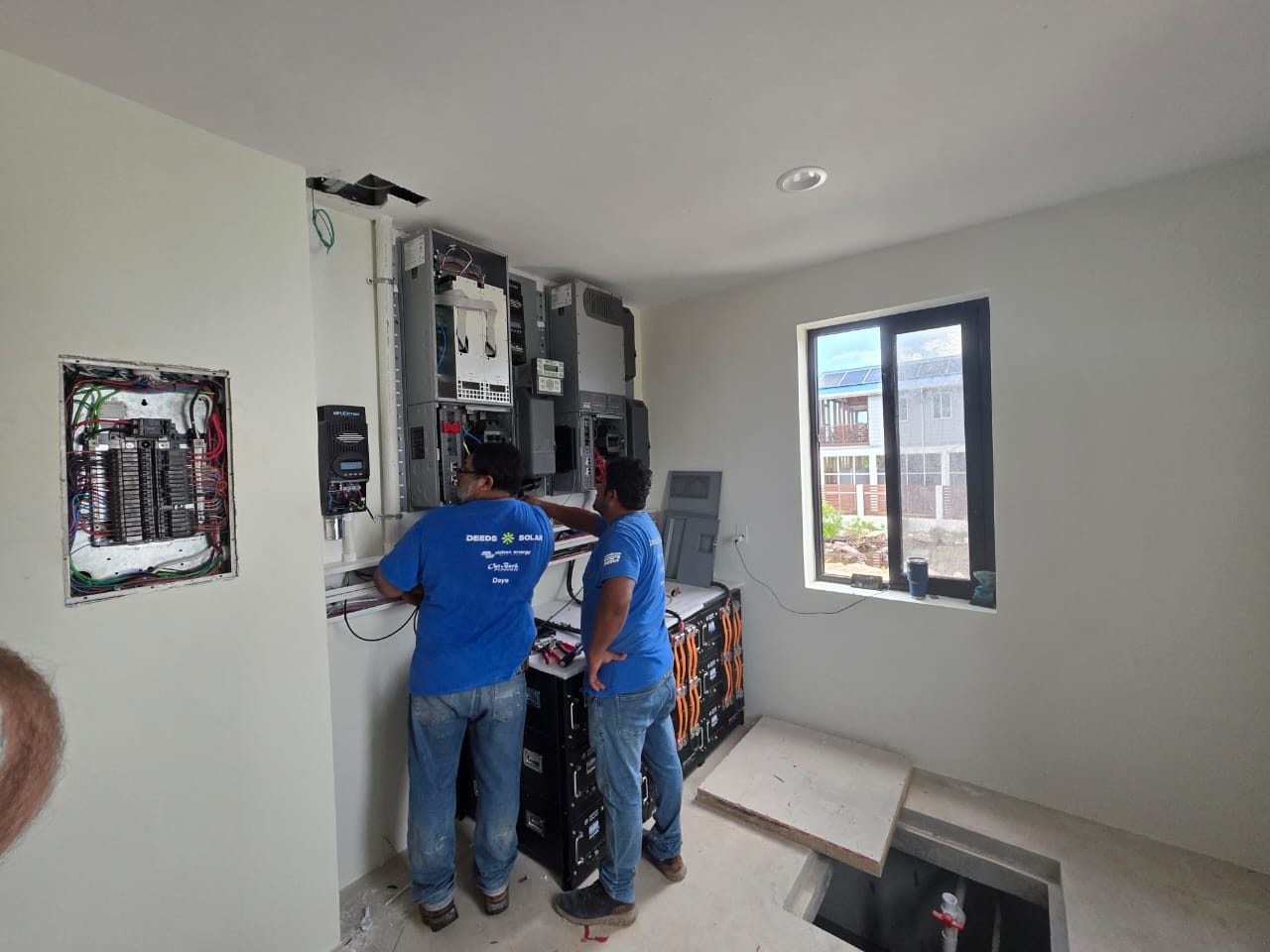
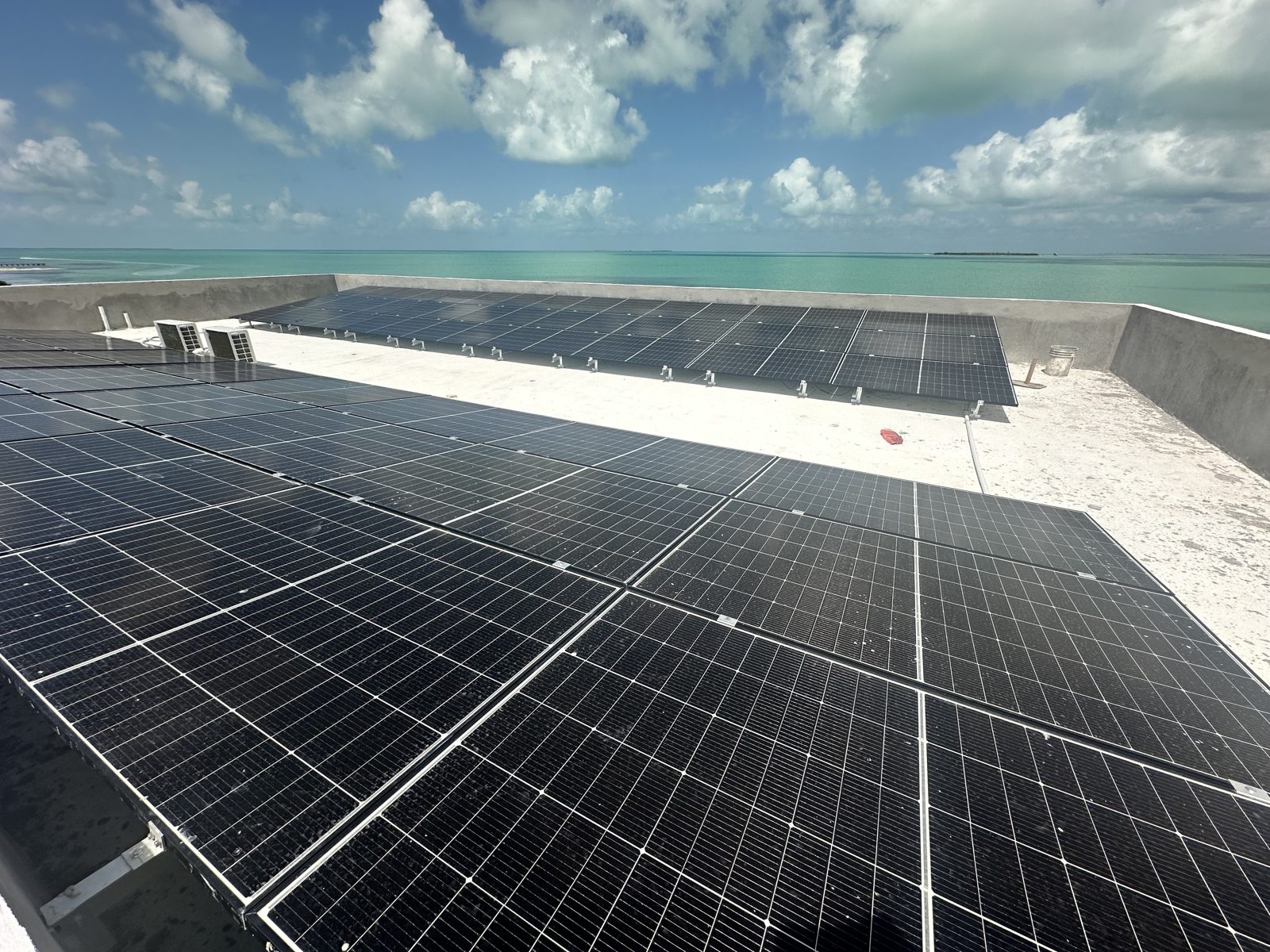
Power is the same story. Deeds Solar Solutions designed and installed the entire system: a roughly 20-kilowatt array of bifacial panels feeding a 107-kilowatt-hour lithium battery bank through dual off-grid inverters, with online monitoring — backed by a 24-kilowatt Generac standby generator (we upgraded it from 14 kW once we added appliances). The casita doesn’t have a separate system — it’s all tied together, one integrated solar-plus-battery setup for the whole property.
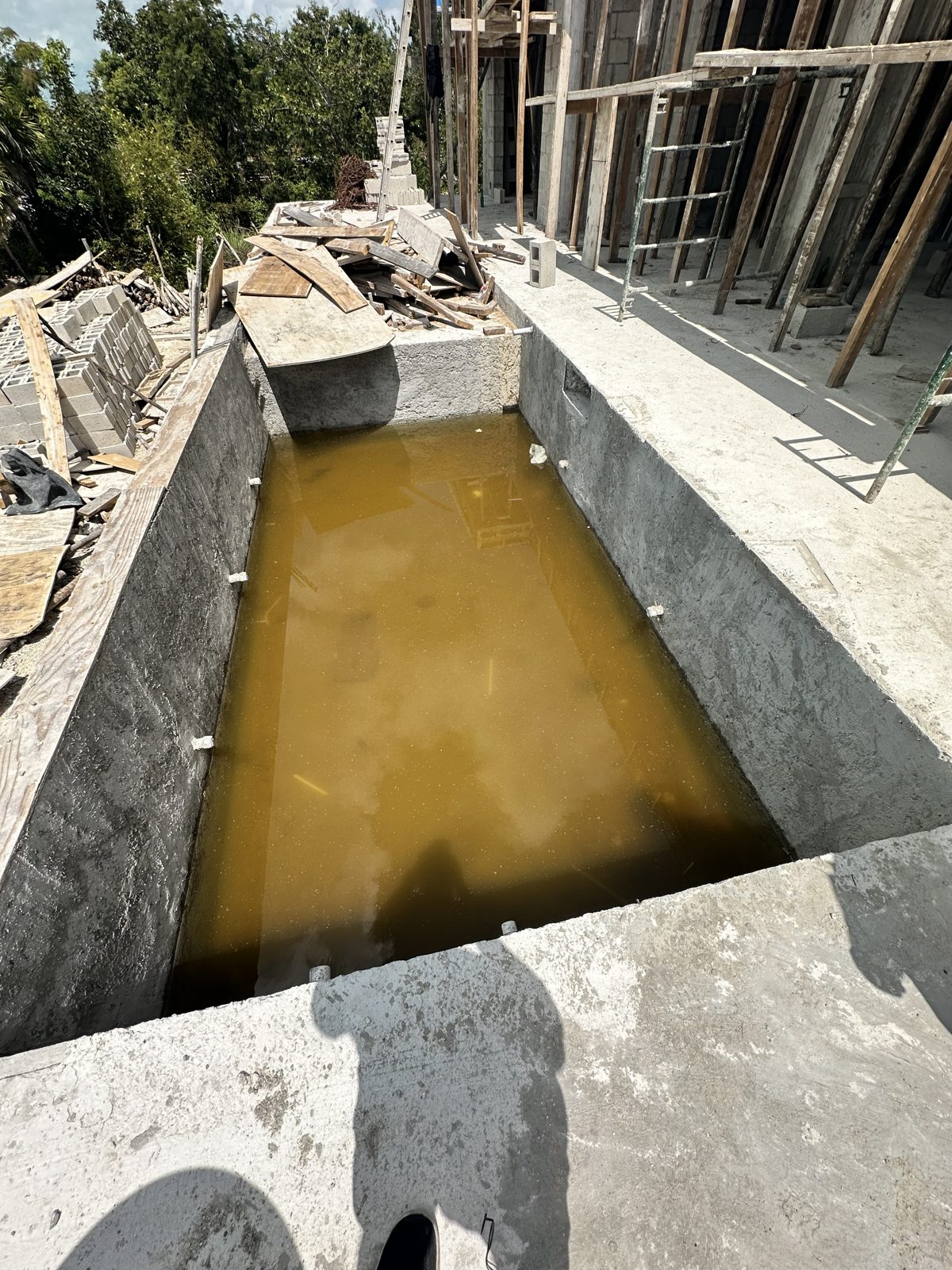
The pool holds about 9,000 gallons. It’s a comfortable 5 feet deep, with a shallow 6-inch platform at one end for young children or for simply sitting in the water, a wrap-around L-shaped bench, and room to stand and look straight out at the ocean. For staying connected, we run Starlink as primary internet with a local Wi-Fi provider as backup — redundancy matters when guests are working remotely or streaming — and a Sonos sound system wired through the home and pool deck.
Giving the land back — greener than we found it
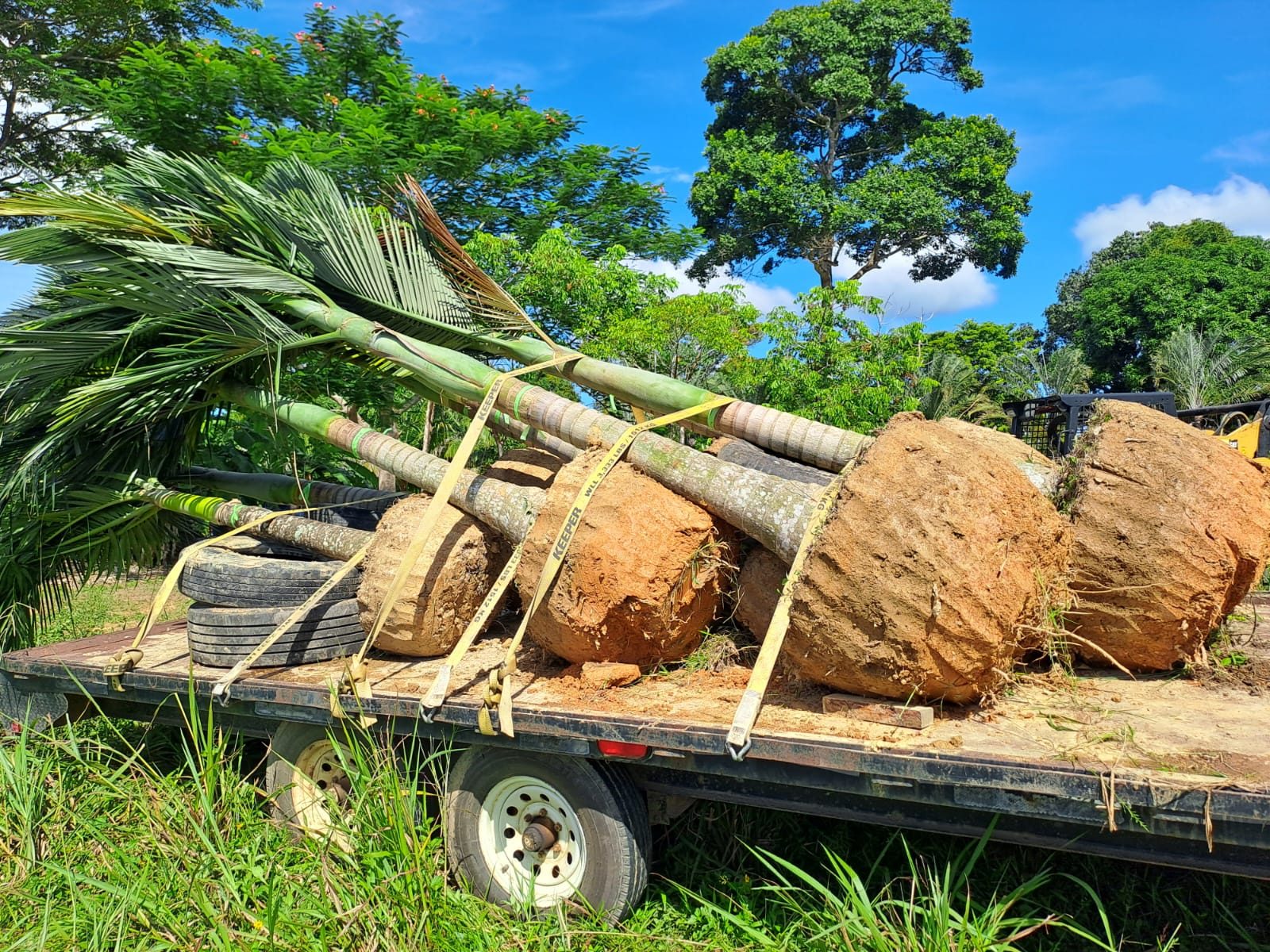
Building meant clearing, but our plan was always to put it back — and then some. We’re now restoring the lot to the vegetation it once held, with a variety of native plants, and we’re adding mangroves along the water. It’s our way to give back to the shoreline that gave us so much, to protect against erosion, and to support the local nurseries and landscapers who make it happen — people like Julian, our Secret Beach landscaper and the island’s go-to for landscaping and maintenance, and Jeremy Flowers, who prepared so many of our plants in pots.
 The single best decision we made
Designing & furnishing from afar
If we could give one piece of advice to anyone building from overseas, it would be this: hire a great interior designer, and treat it as essential, not optional. For us that was Trisha Fox of T. Fox Interiors, and the design, procurement, logistics, installation, and fine detail her team delivered was, without question, the most valuable investment of the entire project. Even Kevin, our builder, was equally impressed.
Trisha and her team didn’t just decorate — they enhanced our vision and brought it to life, flawlessly.
She worked around tough deadlines and ambiguous briefs, and repeatedly stepped outside her comfort zone to help with architectural decisions that look obvious now but weren’t at the time, given how little we knew. She managed the design boards, the furniture and decor selection, the window coverings, the shipping and customs, and the final installation — every detail, two thousand miles away, handled. Beyond the job, she has connected us with the right people, offered ideas and ways to be successful, and become a genuine friend. If you build on this island, start with Trisha.
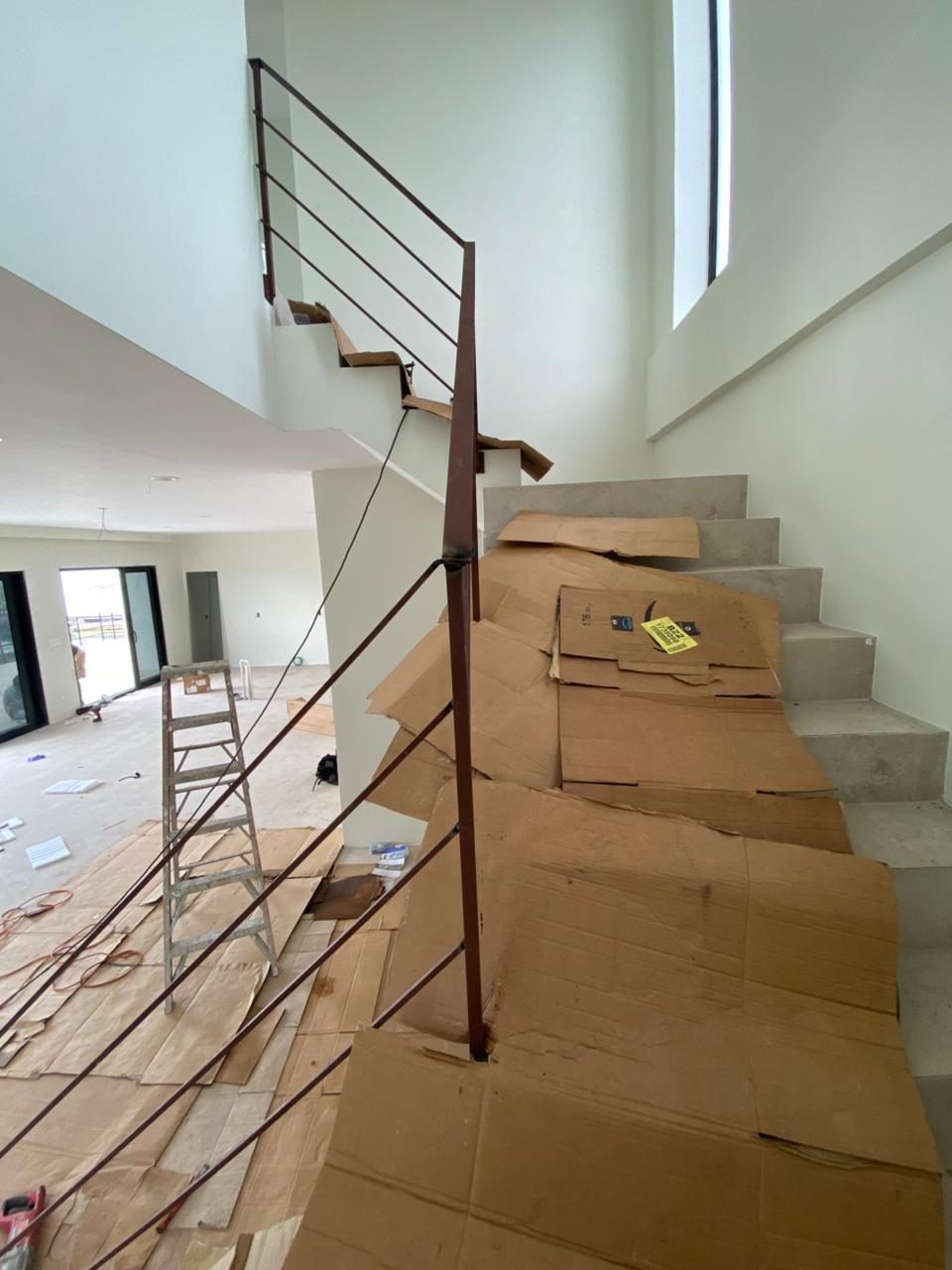
When it all arrived, SS&J Builders — led by Steven, who partners with T. Fox Interiors — handled the final, white-glove installation, placing every furnishing, mirror, light, and piece of art, room by room. Steven’s team also built the beautiful aluminum railings, inside and out, topped with mahogany. (A small-world note: Trisha’s husband, Michael Huyett, is a real-estate agent at RE/MAX under Will Mitchell — he’s who we’d send anyone looking to invest anywhere in Belize, including their new mainland project. You can find Michael here.)
What it cost
We promised honesty, so here it is, in rounded U.S. dollars, drawn from our own construction accounting. Every project is different, but this is a realistic shape for a high-end, built-to-last, off-grid-capable home on Ambergris Caye.
- The land (65′ beachfront parcel)~$395,000
- Core construction — structure, trades, labor & management~$814,000
- Interior design & furnishings~$153,000
- Solar, battery & backup generator~$115,000
- The dock~$70,000
- Custom cabinets & doors~$66,000
- Railings~$41,000
- Landscaping~$7,000
- All in, land + build~$1.66 million
Approximate, USD. The Belize dollar is pegged at about 2:1 to the U.S. dollar.
Here is the number most people actually want. Measured against the finished space — the 3,000-square-foot villa plus the 520-square-foot casita, about 3,520 square feet in all — the build itself came to about $294 per square foot. That figure covers the structure, trades and labor, solar and power, custom cabinets and doors, and railings — the core of what goes into the building — and excludes the land, the dock, the landscaping, and the furnishings, since those vary enormously from one project to the next.
A few honest observations behind those numbers. Core construction — labor, materials, and the trades — was the biggest piece by far, and management ran a standard 15%. On materials, the “it’s cheaper in Belize” assumption only half-holds: we received builder’s discounts on materials, but then paid duty and tax on top. One hard rule we learned: never import wood — it carries a 100% tariff, so all of our lumber and millwork was sourced locally. Two line items surprise people — solar and a great interior designer each ran into six figures — and we’d spend both again without hesitation. And a build like this runs on the order of 15 months, not five — weather alone cost us roughly one to two months of that.
What we’d tell anyone thinking of building in Belize
If you’re reading this with a piece of Belizean shoreline in your imagination, here is the short version of what we learned, the way we’d tell a friend:
Buy through a Belize company and use a real title company. Foreigners can own fee-simple title, seller financing is more common than you’d expect, and a good title company makes owner financing in a foreign country feel safe. Chase the sargassum-free water — the leeward shore is the amenity you can’t build, and it’s what guests pay for. Hire local, and hire people you trust. A builder, designer, and accountant who know the island are worth far more than they cost. Respect the logistics. Everything ships; consolidate loads, budget freight and duty, never import wood, and expect to fill and raise low beachfront land first. Design for the island, not against it: concrete and block for the weather, rainwater capture with real filtration, solar with battery and a generator. And plan for island time — though permitting, happily, was faster here than at home.
Most of all: the relationships are the project. We arrived as strangers and finished with a builder, a designer, a crew, and a roster of small businesses we genuinely consider friends. That, more than the concrete, is what made it work.
The build, start to finish
- Feb 2019First visit to Belize. The greeting on a Belize City street, and that bath-warm, sargassum-free water.
- Mar 21, 2023Flew down to walk the land and meet the sellers in person.
- Mar 23, 2023Signed to buy the 65′ beachfront parcel — direct, with 8% seller financing.
- Jan 2024Paid off the land loan in full; formed Black Orchid Oasis Ltd.
- Jul 2024Lot filled and raised; initial design & permitting with Zaldivar Developments.
- Late 2024Groundwork and first concrete; Caye Design takes the build.
- Feb 2025San Pedro Town Building Unit issues the No Objection & Permit to Commence.
- 2025The main build: shell, block, roof, then mechanicals, solar, and finishes.
- Nov 2025Placed in service — furnished, powered, and ready.
- 2026Doors open. Guests arrive on Secret Beach.
What’s inside: the furnishings
Guests ask all the time where a particular piece came from — so here is the actual list for the villa, room by room, with real product names you can search and buy yourself. Almost everything was sourced and installed through T. Fox Interiors from makers and retailers including Wayfair, West Elm, Amazon, Zara Home, and local San Pedro craftspeople, then shipped, cleared, and installed on-island.
Living room
Wayfair Galesbury stone-top coffee table, Loklun linen side chairs, an SB ottoman and Edmond tray, a Kacie terracotta floor vase, and a Martha Stewart hand-woven jute rug. A Sonos Beam Gen 2 Dolby Atmos soundbar and a Samsung QLED 4K (Q60D) smart TV on a full-motion mount.
Dining
A set of six Wayfair Boho Seagrass dining chairs around the custom mahogany-toned table from Graniel’s, lit by the Wayfair Dainna 3-light natural cluster chandelier; Dine n Decor hemstitch cotton napkins.
Kitchen
A Vitamix 5200 professional blender, CAROTE 22-piece nonstick granite cookware and a Chef Power hard-anodized set, a CAROTE 14-piece knife block, Amazon Basics porcelain and AmorArc terracotta-underside dinnerware, and a Beautiful by Drew Barrymore air-fry toaster oven.
Lighting
A rattan staircase chandelier, the Aadvi basket pendant, and Slavo, Semele, Gwenelle, and Aracelie single pendants throughout; Robbin wicker and Everlie resin table lamps; a Romania USB desk lamp.
Bedrooms & bedding
Platform storage beds with matching nightstand sets, down-alternative comforters in king and queen, EASELAND pillow-top mattress pads, and Cosy House bamboo mattress protectors. A Dainah arch full-length mirror, the Pablo 3-piece mirrored wall set, and a Piper bench.
Textiles & pillows
West Elm Colorblock Silk Stripe (Alabaster) and Honeycomb Silk (Arctic Blue) pillow covers and a Classic Linen cover (Midnight) with down inserts, plus boho and India-chic fringe covers from Wayfair, and custom cushions by Sew What.
Bath
Delta Trinsic towel hooks and rings in Champagne Bronze, Minuover brushed-black framed vanity mirrors, TEXTILOM Turkish hand towels, Kwikset and Berlin Modisch keyed deadbolts, and a SentrySafe digital safe.
Outdoor & pool
Wayfair Siman modular sofas and a Sunbrella-cushioned lounge set, swing chairs, sunbeds and loungers, Adainville concrete side tables and a concrete fire-pit table, handwoven indoor/outdoor rugs, and faux greenery — a 74" yucca and Vickerman 7′ potted palms among Dorlis and rustic-cauldron planters.
Decor accents
Terracotta vessels — Kacie, Keron, and Wrenda plus a ribbed urn — a Bloomingville paper-mâché vase, dried pampas grass, a Carriediosa chunky-knit throw, and West Elm’s 7-ft faux orchid leaf stem, a nod to the villa’s name.
Window treatments
Blackout roller shades with valances and pleated blackout drapes on ceiling tracks by San Pedro Window Treatments, with custom soft furnishings by Sew What.
Brand and product names are listed so guests can find the same pieces; we don’t earn anything from these mentions.
That first stranger was right: every day really is a beautiful day in Belize. We built Black Orchid Oasis so that more people could come and feel what we felt on the water in 2019 — and so that the Belizeans and expats who built it would always have something on this shore to be proud of. Whether you’re here to visit, to dream about building, or to invest, we’d love to host you and tell you the rest in person.
Stay where the story happened
A private chef, a sargassum-free beach, and a villa built by Belizean hands on the calm side of Ambergris Caye. Come for a holiday — or to see what building in Belize really looks like.
Book TodayCredits — the people who made it
Black Orchid Oasis exists because of these Belizean and expat businesses and the people behind them. If you’re building on the island, you could not be in better hands:
- T. Fox Interiors — Trisha Fox. Interior design, procurement, logistics & installation — and the single best decision we made on this entire project. The most valuable investment of the build, and a friend for life. If you build on this island, start here.
- Caye Design — Kevin & Nova. Our builder and construction manager (Kevin) and our flawless project accounting (Nova) — now also the team behind Da Munch House at the entrance to Secret Beach.
- Zaldivar Developments — Javier Zaldivar. Initial architectural design, land filling, and permitting.
- Graniel’s Construction & Cabinet — Avi. Custom doors, cabinetry, and furniture, with first-class attention to detail.
- SS&J Builders — Steven. Furniture & finish installation and the aluminum-and-mahogany railings, in partnership with T. Fox Interiors.
- Hyde’s All Service. Builder of our dock.
- Deeds Solar Solutions. Complete solar, battery, and standby-generator system.
- San Pedro Window Treatments & Sew What — shades, drapes, and custom soft furnishings.
- Julian — our Secret Beach landscaper and the go-to for landscaping and maintenance — and Jeremy Flowers, for preparing plants in pots.
- Belize Concierge & Shipping — Windell. Our point of contact for getting furniture, fixtures, and materials shipped and cleared into Belize — the logistics backbone of furnishing from afar.
- Belize Title Services — Zaida. Title and owner-financing guidance that made buying abroad feel safe.
- Myra Hyde. Consulting on our BTB licensing, permits, and trade licenses — and the work to get us through final BTB inspection so we could list the villa for rent.
- RE/MAX — Will Mitchell & Michael Huyett. Who we’d send anyone looking to invest anywhere in Belize, including their new mainland project — and for helping document our story on YouTube.
- Seavu Media — William. For showcasing the beautiful work of the Belizeans and expats who build here.
- Ryan & Tiffany, Ix Chel Resort & Harvest Cafe. Our eyes and ears on the island — a million questions answered, and the confidence we needed to build in Belize.
Our partners, at a glance:


